 | |
|
|
Dunhuang may not be a household name to most Bay Area residents, but to the modern or ancient travelers on the Silk Road, it is the brightest pearl in the desert. Situated at the westernmost outpost in the early Chinese empire, Dunhuang was a major trading and cultural center along the Silk Road, which connects China with the Western world. Foreign merchants and monks from the West as well as officials and soldiers from central China brought their own cultures to Dunhuang and made the trading center a cultural melting pot. When Buddhism started to spread from India across the Silk Road, Dunhuang flourished to become one of the most important religious centers along the trade route. The economic, military, political and cultural activities taking place at this crossroads gave rise to one of China's earliest Buddhist centers.
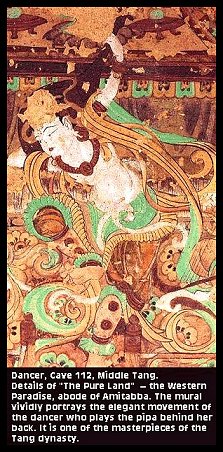
Only a small oasis town located in the desert of northwestern China, Dunhuang became home of the world’s richest and largest treasure-trove of Buddhist manuscripts, wall paintings and statuary. The Mogao Caves, also known as the Caves of the Thousand Buddhas consist of 492 caves with 45,000 murals and more than 3000 painted sculptures. These well-preserved caves span a period of 1,000 years, from the fourth to the fourteenth century, and visually represent with vivid detail a rich and resplendent culture. The discovery in 1900 of a secret library cave and the Diamond Sutra - the earliest printed book in history, not only rekindled the world’s fascination with Dunhuang but also demonstrated its significance in the world history.
Today, Li Zhenfu heads the Art Research Institute at the Dunhuang Research Academy. At the Institue, he works to reproduce the magnificence of the historical frescoes. Li’s collection of Dunhuang paintings has been showcased in Japan, France, India, Taiwan and the Unites States. Living in Dunhuang since 1964 and serving as a Research Fellow at the Academy for thirty years, Li considers the art of Dunhuang to be one of his passions in life. Renowned for his understanding of this art, Li’s exhibition presents a wide range of sophisticated artwork that reflects his great talent and experience. His portraits of celestial beings - serene, lyrical, and timeless - articulate a unique and poetic transformation from the frescoes. The images of Buddhas, bodhisattvas, apsaras, and the desert landscape will captivate Bay Area viewers, and give a new appreciation of ancient rituals and symbols.
Prof. Peng Jinzhang had taught in the Department of Archaeology at Wuhan University for more than twenty years until 1988 when he joined his wife at the Dunhuang Research Academy. Currently, he is a Research Fellow and the director of the Exhibit Museum at the academy. For the last ten years, Prof. Peng has led several major excavations at Mogao site and has published extensively on the archaeological discoveries in the Dunhuang region. His research and study on the esoteric Buddhist art has been well recognized and highly respected. Prof. Peng’s slide-show lectures and presentations promise to dazzle the audience a virtual Dunhuang tour including in-depth art and history representations.
East Meets West -The Sacred Vision of Dunhuang opens to the public on Friday October 13 at 6:00 PM. A special three-hour youth program will be presented on Saturday in conjunction with the exhibition, to foster and encourage the younger generation in learning about history and art. The youth program will include storytelling, docent tour, and various arts and crafts workshops. The World Journal Exhibition Hall is located at 231 Adrian Rd., Millbrae, CA 94030. For more information on map or event schedule, please visit www.silk-road.com or email info@silk-road.com
 | |
|
|
PROGRAM INFORMATION AND SCHEDULE
All events are free and open to the general public.World Journal, 231 Adrian Road, Millbrae, CA 94030. MAP
Stanford University, Building 260, Room 113, Stanford, CA 94305. MAP
Exhibition
Fri 10/13 6-9 PM Opening & Reception 6-7 PMSat 10/14 11-6 PM
Sun 10/15 11-6 PM
Painting Demonstrations
Fri 10/13 7 - 7:30 PMSun 10/15 2 - 2:30 PM
Lectures at the World Journal Exhibiton Hall (in Chinese)
Sat 10/14 2: 15 - 3:15 PM “Dunhuang Tales and Legends” by Zhu QiSat 10/14 3: 30 - 4:30 PM “The Sacred Vision of Dunhuang” by Peng Jinzjang
Please note that both Chinese lectures at World Journal need reservation. Please email Silkroad Foundation and specify number of the seats to be reserved for you.
Lectures at Stanford University (in Chinese and English)
Tue 10/17 7:30 PM “Tantric Motifs in the Mogao Caves” by Peng JinzhangWed 10/18 7:30 PM “The History and Discovery of the Dunhuang Secret ‘Library Cave’” by Peng Jinzhang
Youth Programs ( in English)
Sat 10/14 2 - 5 PM Storytelling, Doll making, Art & craft workshops, Docent tour
Related Links
The International Dunhuang Project (IDP) - established in 1993 to promote the study and preservation of manuscripts and printed documents from Dunhuang and other Central Asian sites.UUNESCO World Heritage List DunHuang Grottoes
Dunhunag Showcase
